


Dudhwa Safari Experiences
WhatsApp Plan your journey
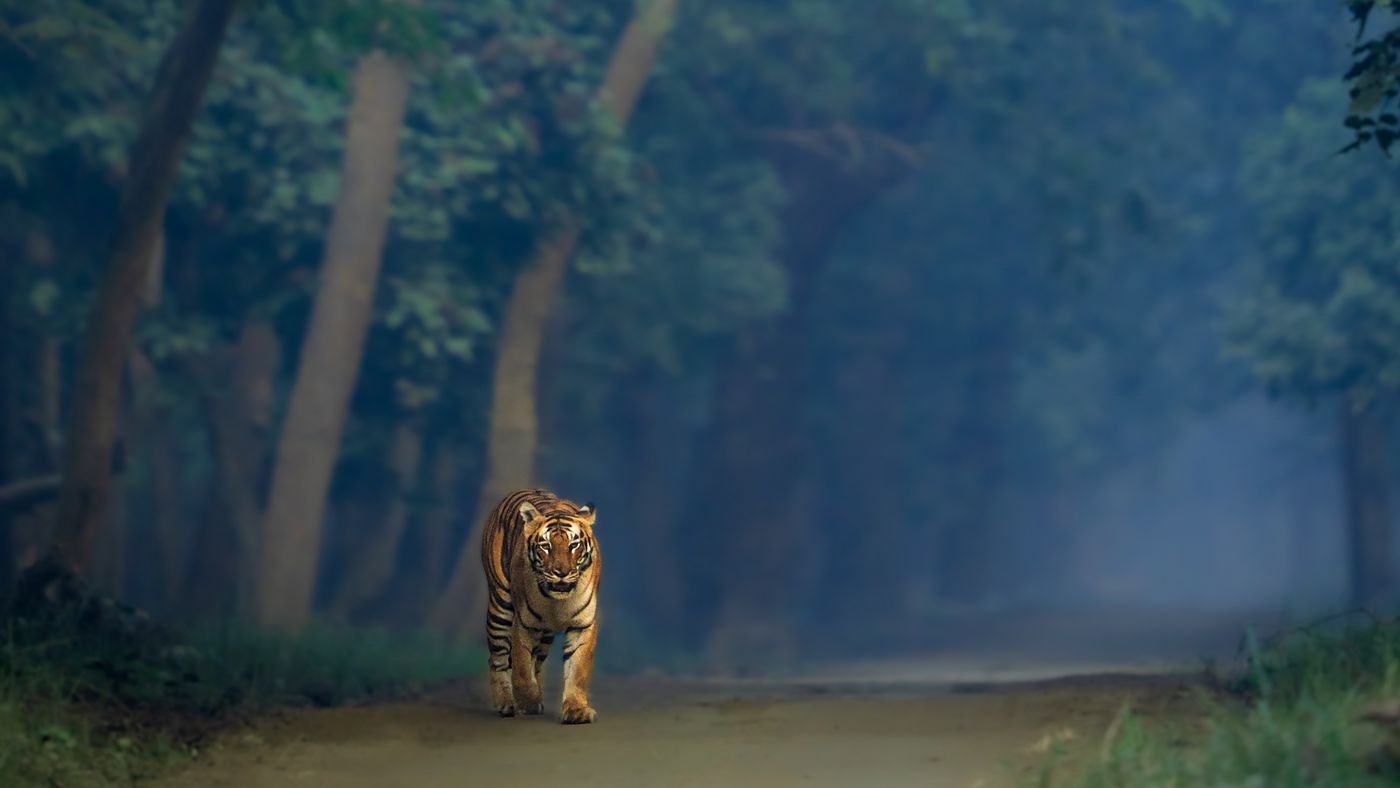
A tiger walking towards the camera along a misty forest road under an arch of trees in Dudhwa at first light
Dudhwa · Kishanpur · Katarniaghat

Private wildlife journeys through the Terai.

Forest, grassland and river, designed as one considered journey around your season, your interests and your pace, by a naturalist who has spent years reading this landscape.

Season: mid-November to mid-June · Private journeys only

We don't arrange safari slots. We design how you experience the Terai.

A Dudhwa visit can be built around a permit and a jeep. Ours begin with a different question: what do you want to understand here? The sal forest, the tall grassland and the river each ask for different hours, different zones and a different kind of attention.

Getting that sequence right, for the month you travel and the animals and birds you care about, is the work. The result is a private journey with one vehicle, yours alone, and one person responsible for it from the first conversation to the last morning in the field.

A tiger in Dudhwa rubbing its cheek against a sal tree trunk, leaving a scent mark for other tigers
Scent marking on a sal trunk: one of the signs a naturalist reads.
Why Dudhwa

A landscape that deserves more than a tiger count

Dudhwa sits at the eastern reach of the Terai Arc, the corridor of forest, floodplain and grassland that runs along the base of the Himalaya. Terai comes from the Sanskrit for "lowlands": the belt where Himalayan rivers slow, spread out and lay down centuries of silt. The ground changes character every few hundred metres. Dense sal forest opens without warning into elephant grass that can stand seven metres high by the end of the monsoon, and between the two lie wetlands, oxbow lakes, seasonal marsh and slow rivers, each holding a different assembly of species.

Here the grasslands still hold what most of the corridor has lost: a resident population of swamp deer, one of India's rarest deer, and the greater one-horned rhinoceros, hunted out of this stretch of India entirely, reintroduced from Assam and Nepal in the 1980s, and today found nowhere else in northern India in a genuinely wild, self-sustaining population.

A good naturalist in this landscape will teach you to read a forest, rather than simply drive you toward a radio call.

  • A pugmarkpressed fresh into the mud of a forest track before sunrise tells you where an animal walked in the last few hours.
  • A langur's alarmrepeated from the canopy, then silence from every other species in earshot: a predator is moving close, well before it steps into view.
  • A raked scrapeon a tree trunk at shoulder height is a territorial signature left for the next tiger that passes, sometimes days later.
The three landscapes

Forest, grassland, river

Dudhwa National Park, Kishanpur Wildlife Sanctuary and Katarniaghat Wildlife Sanctuary together form the Dudhwa Tiger Reserve complex. Each is a different way into the same landscape, and a well-designed journey chooses between them deliberately.

A tiger walking towards the camera down a grassland path in soft morning mist
Forest & grassland

Dudhwa National Park

The heart of the reserve: tall, straight-trunked sal forest broken by open grassland and wetland. This is where a morning is often spent reading sign rather than chasing a sighting, and where the grasslands hold the rhinoceros and swamp deer that make Dudhwa unlike any other tiger reserve in northern India.

Look forTiger and its signs, greater one-horned rhinoceros, swamp deer, sal-forest and grassland birds.

A tiger stepping down to drink at a still pool below tall grassland
Grassland & wetland

Kishanpur Wildlife Sanctuary

Adjoining Dudhwa, Kishanpur shares its grassland story and extends it. Together the two hold a resident swamp deer population, and they introduce the Terai's most distinctive birds, among them the sarus crane, the tallest flying bird in the world and a species that pairs for life.

Look forSwamp deer, sarus crane, the rare swamp francolin, and the spot-bellied eagle-owl, known locally as the "ghost of the forest."

A gharial floating at the surface of a misty river lined with tall reeds
River

Katarniaghat Wildlife Sanctuary

An entirely different mode of travel: a boat on the Girwa in place of a jeep track. Gharial, the narrow-snouted crocodilian now critically endangered across its range, bask on the sandbanks in numbers found almost nowhere else, while one of India's last viable populations of the Gangetic dolphin surfaces in the same current.

Look forGharial, Gangetic dolphin, mugger crocodile, freshwater turtles and wetland birdlife.

Together they make Dudhwa a journey rather than a drive: the meaning is in the sequence, not only in each chapter.

A tiger crossing a forest track between tall sal trees in Dudhwa National Park, in low golden light
Where forest meets grass

The edge between sal forest and tall grass is where a morning in Dudhwa is most often decided.

From the field

The tigers of Dudhwa

Photographs from the Dudhwa landscape. Select any photograph to see it full screen. For the rhinoceros, swamp deer, elephants, gharial and birds, see the wildlife of Dudhwa.

Signature journeys

Four ways to know the Terai

Starting points, not fixed packages. Each is privately designed around your dates and refined with you before anything is confirmed.

Dudhwa · Kishanpur · Katarniaghat

The Terai Wilderness Journey

Our fullest reading of the eastern Terai. Forest, grassland and river in one unhurried sequence, so that the landscape's logic becomes visible across the days rather than arriving as a series of separate drives.

Discuss this journey
For
Travellers who have done tiger safaris before and now want the whole landscape; and those who know Africa's safaris and want to see how India differs.
Suggested length
Around seven nights
Wildlife focus
Tiger and its signs; rhinoceros and swamp deer in the grassland; gharial and Gangetic dolphin on the Girwa; birdlife throughout.
Pace
Unhurried. Time in each landscape rather than the most drives in the fewest days.
Safari rhythm
Morning and afternoon drives in zones chosen for the season, a boat on the Girwa at Katarniaghat, and the middle of the day left quiet.
Where you stay
Chosen for each part of the journey by proximity to the zones you will use and for quiet; recommended individually in your proposal.
Dudhwa · Kishanpur

Dudhwa & Kishanpur — Forest and Grassland

A focused journey through the sal forest and the open grasslands that make Dudhwa distinct: the country of the rhinoceros and the swamp deer, read slowly and in the right light.

Discuss this journey
For
Travellers with a shorter window, families, and anyone who wants depth in two landscapes rather than breadth across three.
Suggested length
Four to five nights
Wildlife focus
Tiger, greater one-horned rhinoceros, swamp deer; sarus crane, swamp francolin and the grassland birds.
Pace
Focused, with room to return to a zone that is working.
Safari rhythm
Morning and afternoon drives, with forest and grassland zones sequenced for the season and the hour.
Where you stay
One base, chosen for access to both landscapes; recommended in your proposal.
Dudhwa · Katarniaghat

Dudhwa & Katarniaghat — Forest to River

Jeep, then boat. Dudhwa's forest followed by the Girwa at Katarniaghat, where the Terai's quieter river story is told: gharial on the sandbanks, dolphins in the current, and for the patient observer, the slim but genuine possibility of a fishing cat.

Discuss this journey
For
Travellers who want contrast; photographers drawn to river light and reptiles; anyone who has seen tigers and wants to see what else the Terai holds.
Suggested length
Around five nights
Wildlife focus
Tiger and forest sign; gharial, Gangetic dolphin, mugger crocodile, freshwater turtles; river and wetland birds.
Pace
Two distinct halves, with a transfer between forest and river.
Safari rhythm
Jeep drives in Dudhwa; boat time on the Girwa, timed for light and activity.
Where you stay
Two bases, one near the forest and one near the river; recommended in your proposal.
Dudhwa · Kishanpur · Katarniaghat wetlands

The Terai for Birders

Birding asks for a different kind of attention than a mammal drive, and here it is built into the journey rather than fitted around the tiger. Grassland specialists, forest owls and the wetlands of Katarniaghat make the Terai a birding destination in its own right.

Discuss this journey
For
Serious birders and natural historians; photographers working with birds.
Suggested length
Five to six nights
Best season
Mid-November to February, the months of peak migratory arrivals and soft morning light.
Wildlife focus
Sarus crane, swamp francolin, spot-bellied eagle-owl and wetland species, with the mammals as they come.
Pace
Slow. Longer stops, earlier starts, time to wait for a call to resolve into a bird.
Where you stay
Chosen for access to grassland and wetland at first light; recommended in your proposal.

Privately designed around your requirements. Each journey is priced individually once we understand your dates, stays and the landscapes you want to include. We take on a limited number of journeys each season, so that each one receives the attention it needs.

Our approach

Journey design, not safari inventory

Every Dudhwa journey is built the same way: around you, rather than around whatever safari slots happen to be available.

Designed around

  • SeasonWinter mist and birdlife, or the hotter months when wildlife concentrates at water. Each brings a different journey.
  • Your interestsTiger, rhinoceros, the river, birds, or the whole landscape.
  • PaceHow many drives a day, and how much quiet in between.
  • Photography & birdingZones, timing and stops chosen for the image or the species, not the schedule.
  • ComfortWhere you stay, how you travel between landscapes, and what matters to you at the end of the day.
  • LandscapeForest, grassland, river, in the sequence that makes sense of them.
  • Time availableFour nights or two weeks, and whether Dudhwa is the whole journey or one part of it.

What stays constant

  • One vehicle, yours aloneFor the length of your journey. No shared jeeps, no strangers' schedules.
  • No fixed departuresYou travel when it suits you and the season.
  • Specialist ground handlingEvery permit, zone and transition between landscapes, handled on your behalf.
  • One person, throughoutFrom the first conversation to the last morning in the field, one person is responsible for the whole journey.
  • Conservation, includedA working part of how the journey is designed, not an add-on presented at the end.
A tiger stepping out of tall grass at the edge of the forest in soft winter light

For photographers

With one vehicle that is yours alone, you decide when to wait. Zones are chosen for light as well as for sightings, and the winter months bring the dawn mist over the grasslands that photographs beautifully and tends to bring animals to forest edges and water in the first hour. Tell us what you shoot and what you want to come home with, and the journey is shaped around it.

A tiger walking through a misty sal forest in Dudhwa, the forest floor covered in dry leaves
First light in the sal

Mist in the forest, and a tiger moving through it: the hour our journeys are built around.

How safari works in Dudhwa

A different grammar for the same pursuit

For travellers used to Africa's largely unrestricted game drives, Indian reserves work differently. None of it is a limitation; it simply rewards knowing the system well, and that is where much of a specialist ground team's value lies.

  • ZonesEach reserve is divided into defined tourism zones, and the right zone depends on the season and on what you hope to see.
  • PermitsVehicle numbers are capped per zone per drive, so the right permit on the right date matters.
  • Safari slotsMorning and afternoon drives, rather than a full day in the field.
  • Naturalist and local guideIn most reserves a mandatory local guide rides alongside your naturalist.
  • SequenceThe order of zones and landscapes is planned so the Terai's logic is visible across your days, not experienced as disconnected stops.
When to come

The Terai through the year

The reserves are open from mid-November to mid-June and close for the monsoon the forest depends on to regenerate. The cooler months bring comfort and birdlife; the hotter months concentrate wildlife around the water that remains, at the cost of considerable heat. We will tell you honestly what that trade-off involves before you commit.

Seasons in Dudhwa and the Terai
SeasonMonthsConditionsWildlife & birdingBest for
WinterMid-November – FebruaryCool, crisp mornings (5–20°C); mist over grasslands at dawnPeak migratory bird arrivals; comfortable, extended game drivesFirst-time visitors, birders, photographers wanting soft light
Late winterMarchWarming steadily (15–30°C); forest still greenWildlife activity high before the heat sets inTravellers wanting strong odds without peak summer heat
SummerApril – mid-JuneHot, often 35–45°C by May; water sources shrinkingHighest tiger and rhino sighting odds as wildlife concentrates near waterExperienced travellers prioritising sightings over comfort
MonsoonMid-June – mid-NovemberHeavy rainfall; reserves closed to visitorsForest regeneration — the closure is ecological, not administrativeNot open for safari travel
Going beyond the Terai?

Dudhwa can be the whole journey, or the beginning of one

If your time in India extends beyond Dudhwa, we can design a wider private wildlife journey across other landscapes. Dudhwa sits at the eastern end of the Terai Arc, which continues west through Pilibhit to Corbett, and across the border into Nepal's Bardia and Chitwan. Travellers with more time often pair it with something entirely different, such as the tidal wilderness of the Sundarbans, or with the central Indian forests, the Western Ghats or the Eastern Himalaya.

Tell us about your wider plans

Tell us how long you have in India. If another landscape would serve what you are looking for better than more days here, we will say so.

How it works

A conversation first, then a journey

  1. Tell us what you're looking forA few lines through the form below or on WhatsApp is enough to begin.
  2. We speak with youA call at a time that suits you, with the person who will design your journey.
  3. We understand how you like to travelYour interests, your pace, who is travelling, and how Dudhwa fits into the rest of your plans.
  4. We design the journeyA written proposal: the landscapes, the sequence, the stays and the reasoning behind each choice.
  5. We refine it with youNothing is fixed until it reads the way you want it to.
  6. You confirmAn advance secures the journey; the permits and arrangements follow.
  7. We handle everything on the groundPermits, zones, transfers and the days themselves, with one person accountable throughout.
Questions

Before you write to us

Do you sell safari permits or jeep seats?

No. We design complete private journeys. Securing the right zone and permit on the right date is part of the ground handling we take care of within your journey, alongside your stays, transfers and the sequence of landscapes.

When is Dudhwa open?

From mid-November to mid-June. The reserves close for the monsoon, which the forest depends on to regenerate. November to February is cool and exceptional for birds; March to May is hotter, with wildlife concentrating around water.

How many nights should we allow?

For Dudhwa and one neighbouring landscape, four to five nights. To experience forest, grassland and river together, allow around a week. If Dudhwa is part of a longer India journey, we will suggest how much time it deserves within the whole.

Is the vehicle private?

Yes. One vehicle, yours alone, for the length of your journey. In most reserves a mandatory local guide rides alongside your naturalist.

How much does a journey cost?

Each journey is designed and priced privately. The cost depends on the season, the length, the stays you prefer and how many of the three landscapes you include. We send a written proposal after we have spoken, so the figure reflects the journey you actually want.

Can Dudhwa be combined with other parts of India?

Yes. Dudhwa pairs naturally with Pilibhit and Corbett along the Terai Arc, with Nepal's Bardia and Chitwan, or with a very different landscape such as the Sundarbans. We design these wider journeys too, so you deal with the same people throughout.

We are travelling from outside India. Can you help?

Yes. We plan for travellers from India and abroad, and can design the journey from your arrival in India to your departure. Write to us on WhatsApp or through the enquiry form, whichever suits your time zone; we reply by email or WhatsApp, as you prefer.

Begin

Let's design your Dudhwa journey

Tell us a little about what you have in mind. The person who will design your journey reads every enquiry and replies personally, usually within 24 to 48 hours.

  • Private journeys only, one vehicle, yours alone
  • A conversation before any proposal
  • No obligation until you confirm
Your interests (choose any)